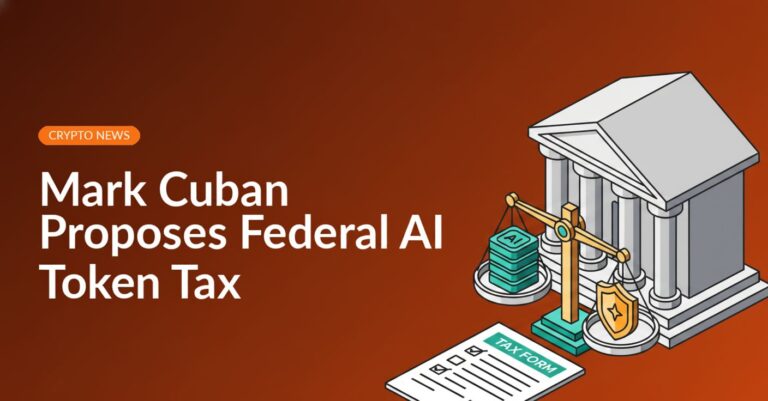

Mark Cuban Proposes Federal AI Token Tax
Mark Cuban has proposed introducing a federal tax on AI tokens. He compared critics of the idea to early opponents of cryptocurrency regulation.
Stablecoin regulation and institutional participation dominated discussions at Consensus 2026. Industry leaders also addressed AI-driven payments and ongoing market volatility.
Iran has launched Hormuz Safe, a state-backed maritime insurance platform settled in Bitcoin for cargo transiting the Strait of Hormuz. Officials project more than $10 billion in annual revenue.
Sygnum has executed live on-chain transactions using an AI agent within a regulated Swiss banking framework. Clients retained full custody as private keys remained on their own devices.
The Verus-Ethereum Bridge was reportedly drained of $11.58 million in crypto assets. The incident adds to more than a dozen DeFi exploits recorded in May 2026.
Non bridge DeFi lending exploits reached $30.9 million over 12 months, equal to 3 basis points of average TVL. Recoveries reduced net losses to 3 basis points.
BeInCrypto has published its 2026 long list for Autonomous Agentic Payments, naming 10 firms across stablecoin, protocol, and identity infrastructure. The winner will be announced in June 2026.
Binance has added oil price trading contracts and expanded its use of AI in cybersecurity. The exchange also introduced a Withdrawal Protection feature to address irreversible transfer risks.
Consensus Miami 2026 highlighted stablecoins, institutional engagement, and AI-driven security changes. Discussions focused on infrastructure, compliance, and trade finance use cases.
CME Group and ICE have reportedly asked US regulators to examine Hyperliquid over market manipulation and sanctions concerns. The debate centers on its internal liquidity model and token linked revenue structure.